Call Today: (877) 966-7846 | (512) 439-1000
Texas Orthopedics, Sports & Rehabilitation Associates

Wednesday, October 14, 2015

You CAN Work Out Your Ankles! 3 Injury-Preventing Exercises


Football players' injuries are regularly splashed across the sports pages at this time of year. Concussions, pulled hamstrings and torn ACL's are all pretty common. Recently, ankle injuries, such as fractures and sprains, have also made front page news.

Eddie Lacy, of the NFL's Green Bay Packers, and Malik Zaire, start quarterback of the University of Notre Dame, suffered serious season-ending ankle injuries. While there is no controlling what happens on the field, for a professional or recreational athlete, you can condition your ankles so that they are at their strongest to prevent an injury.

Strengthening ankle joints and surrounding tissues help to decrease the severity of an injury and also help prevent painful conditions such as shin splints and Achilles tendonitis.

Check out these exercises for stronger ankles:
  1. Use a resistance band by placing it around the top of the foot, then curl toes at the end of the movement. Complete three sets of 20 in each direction. 
  2. Perform simple calf raises, in both sitting and standing positions. Aim for three sets of 20. 
  3. Try plyometric drills with swift, jumping type movements and rapid recoveries, such as "scissor hops" and standing/jumping squats. Do each exercise 10 to 15 times. 
Learning how to balance well on your ankles keeps them strong and allows you to control your feet and body more effectively. Practice standing on one foot for several second, working up to one full minute, then switch, and repeat.

Keep up with Texas Orthopedics news by following us on Facebook and Twitter (@TexasOrthopedic).

Monday, October 12, 2015

Thank You, Physician Assistants


Physician assistants work tirelessly on behalf of the physicians they assist as well as the patients whom they treat. Their role in our office is invaluable.

For this reason, Texas Orthopedics salutes our amazing physician assistants and all PA professionals during National PA Week October 6-12.

There are currently more than 100,000 certified PAs across the country, and it is considered one of the fastest-growing professions today (American Academy of Physician Assistants). Physician assistants are highly trained individuals able to prescribe medications and perform many of the same tasks as a regular doctor. They are instrumental in providing more patients high-quality, cost-effective medical care once only available from a doctor.

National Physician Assistants Week has grown from just a single day celebrated historically on October 6 since 1987 to commemorate the 20th anniversary of the first graduating class of PAs from the Duke University PA program. October 6 is also the birthday of the PA field's pioneer and founder, Dr. Eugene A. Stead, Jr.

We are fortunate to have such a great group of PAs supporting our patients.

Keep up with Texas Orthopedics news by following us on Facebook and Twitter (@TexasOrthopedic).

Wednesday, October 7, 2015

Texas Orthopedics Sponsors Run for the Water

Texas Orthopedics is excited to sponsor Run for the Water, one of Austin's largest and most popular charity-produced races. And many of our employees are going to put on their running shoes to participate in the 10 mile and 5K run. We are so pleased that we're able to contribute to such an important cause and fun local event!

Now in its ninth year, Run for the Water is produced and benefits the Gazelle Foundation, an Austin-based non-profit improving the lives of citizens of Burundi, Africa, through the building of water systems.

Learn more about Run for the Water and find out how you can participate.

And keep up with Texas Orthopedics news by following us on Facebook and Twitter (@TexasOrthopedic).

Bike Injuries Jump Among Adults


In Austin, it's not uncommon to see cyclists whizzing past you on any given road at any given time of day. While biking is a great form of exercise, there are some risks associated with this popular pastime, especially for adults.

A recent study published in the Journal of the American Medical Association reported that injuries among adult cyclists have risen steadily since 1998, with the largest increase among adults over 45 years old.

Data was collected from 1998 to 2013 from approximately 100 emergency rooms nationwide via the National Electronic Injury Surveillance Systems. Highlights include: 
  • Bike injuries increased by 28% while hospitalizations from bike injuries increased 120%
  • The rate of hospitalizations among people over 45 grew from 39% to 65%
  • Cyclists' arms and legs were injured most often, with head injuries increasing from 10% to 16%
This rise in injuries is due to a few reasons: More cyclists on the road and more are traveling in urban areas, which tend to have traffic congestion and other road dangers.

Here are a few reminders to keep you safe, no matter what your age:
  • Ride with a partner or cycling group - there are safety in numbers.
  • Obey all traffic signals and weather warnings, and plan your travel route before hitting the road. 
  • Wear a properly fitting helmet and shoes, as well as reflective gear in the early morning or evening hours.   

    (Adapted from CNN.comhttp://www.cnn.com/)

    Keep up with Texas Orthopedics news by following us on Facebook and Twitter (@TexasOrthopedic).

Wednesday, September 30, 2015

Strong Hips = Happy Knees


If you are a runner, there's a good chance you've suffered from "runner's knee" at some point. While the pain originates in the knee joint, there's another joint not too far away that can help combat this pain... the hip joint.

New research suggests that rehabilitation exercises incorporating the hip - instead of just the knee - can help alleviate this patellofemoral pain, or runner's knee.

Scientists reviewed 14 separate studies involving runners, and here is what they discovered: 
  • Performing exercises to build strength and endurance in the hip muscles led to decreased knee pain and improved joint function when compared with therapy focused on quadriceps muscles alone. 
  • Using heavy weights to strengthen hip and glute muscles proved beneficial over the long-term.
  • Alternating movements/reps between the knee and hip while performing rehab exercises was associated with reduced pain and improved function. 
Because runner's knee can flare up frequently, it is ideal to keep hip conditioning as part of your regular running routine. Using a resistance band is helpful, as well as the following exercises for strengthening hips: 
If your knee pain is constant or severe, contact us. 

(Adapted from Runner's World) 

Keep up with Texas Orthopedics news by following us on Facebook and Twitter (@TexasOrthopedic).

Monday, September 28, 2015

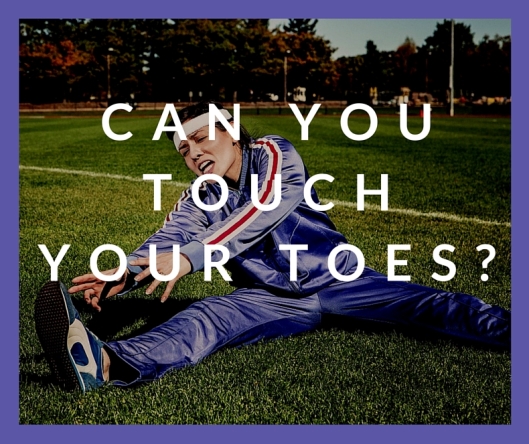
Can You Touch Your Toes?


Can you touch your toes? Really touch them? Proper form dictates that you bend all the way at the waist/hips and fold over similar to closing an old-fashioned flip phone.

So why is this such a challenging, physical task for so many? For one thing, our flexibility wants as we age. Another factor is likely the amount of time we spent sitting at a desk or in a car these days.

Sitting for long periods of time causes your hip flexors to actually shorten. The hip flexors attach to the mid and lower back and are instrumental in bending, along with your abdominals and glutes.

If the hip flexors are shortened or tightened, flexibility can decrease in your core, and ultimately throughout your entire body.

To keep hip flexors surrounding tissues limber, here are just a few exercises to try a couple of times a week, and you will be touching your toes in no time!

Hip Flexor Release
  • Use two balls together (lacrosse balls work well), and lay your stomach with balls placed just below hip bone. 
  • Bend the knee on the side of the release back to a 90-degree angle.
  • Swing leg side to side for several reps repeat.
SI Mobilization (for the Sacroilic joint in the pelvis)
  • Lay on one end of a foam roller so that the tip of foam roller is flush against center of pelvis. 
  • Raise both legs up with knees straight and repeat.
Inner Thigh Squats
  • Place feet shoulder width apart with toes out at a 45-degree angle.
  • Squat as you bring hips back like you are sitting in a chair that is too far behind you.
  • Extend knees outward, and lower yourself as much as possible while keeping balance, then repeat.
If you experience severe pain with these, or any new exercise or workout, you may want to give us a call.

(Courtesy of Men's Journal).

Keep up with Texas Orthopedics news by following us on Facebook and Twitter (@TexasOrthopedic).

Wednesday, September 23, 2015

Men's Bones vs. Women's Bones


Men are from Mars, and women are from Venus so the saying goes. And now research suggests that how a man's and woman's body reacts to injury or illness may be quite different, particularly for orthopedic injuries.

A recent report in the June issue of Journal of the American Academy of Orthopaedic Surgeons analyzed several studies on the difference between male and female orthopedic issues. Here are a few highlights:

Bones:
  • Men are more vulnerable to fractures in fingers and hands.
  • Women suffer more fractures or sprains to ankles and feet, likely due to high-heeled shoes.
Muscles/tendons: 
  • These soft-tissue injuries are more common in men, such as tears to the Achilles tendon, distal biceps, quadriceps and pectoral tendons. 
  • Men suffer Achilles tendon tears about three times as often as women. 
Osteoporosis:
  • Women are more susceptible to hip fractures from osteoporosis, but men with osteoporosis who have hip fractures are more apt to suffer serious complications. 
  • Although osteoporosis strikes men and women, it is generally perceived to be a women's disease and often goes overlooked in men.
 Knees:
  • Women are at higher risk for Anterior Cruciate Ligament (ACL) tears than men, especially when playing certain sports. This may be due to reproductive hormones affecting joint looseness as well as anatomical differences in pelvis width, leg alignment, and knee articulation. 
  • Following an ACL tear, women are less likely than men to return to a sport and are at greater risk of injuring the opposite knee/ACL in the future. 
The results are interesting. We're already seeing gender-specific guidance on ACL injuries and other injuries and expect to see more with additional comprehensive studies.  

(Courtesy of U.S. News & World Report - Health).

Keep up with Texas Orthopedics news by following us on Facebook and Twitter (@TexasOrthopedic).