Call Today: (877) 966-7846 | (512) 439-1000
Texas Orthopedics, Sports & Rehabilitation Associates

Monday, November 15, 2010

Pain Pills- part 4


Post provided by Barbara Bergin, MD

So why do some people use a ton of pain pills and other’s don’t? Umm, it’s complicated.

1) Some people have a low tolerance for pain. It’s that simple and yet it’s that complicated. It’s hard to know whether it’s something psychological or physiological. No one wants to feel pain but everyone is different in their ability to tolerate it. And there is no pain pill out there that is going to keep you from feeling pain altogether, unless it also makes you stop breathing. Right…if you’re not breathing you’re not feeling pain. But there is some level of narcotization which will leave you not caring about the pain.

2) Some people have a high tolerance to the pain pills. That’s another enigma. I can’t explain that one in a few paragraphs. It’s also multi-factorial. Suffice it to say that it’s something genetic or physiological, or metabolic. It’s really not that important to know. The outcome with these folks is not any different than the folks who have no tolerance for pain. They end up needing a lot of pain pills.

3) Some patients get into the habit of taking a lot of pain pills. It just sneaks up on them and on their docs. They have a painful injury or surgery and they get plenty of pain meds when they ask for them. It seems reasonable to the doctor because their patient has a legitimate reason to take pain meds. After an extended period of using them, they just become habituated to their use and then it’s really hard to back down. Many patients have chronic conditions. It’s almost impossible to back down on pain pills in the face of persistent pain or worse; progressively escalating pain. It takes a tremendous amount of patience on the part of the doctor, along with willpower and newfound tolerance for pain on the part of the patient. It’s really one of the hardest problems I deal with.

4) Some patients are sharing their pain meds with friends and family. They’re very good hearted and really hate to see loved ones in discomfort. I’m sorry, but that’s against the law. And it’s probably the reason why some patients use up 40 narcotic pills in two days.

5) Some folks are selling their pain pills. It’s one of the other reasons patients use up 40 pain pills in 2 days. It’s also against the law. These patients get really good at fooling us docs. They’ve got it down to a science and it sometimes takes us awhile to figure it out. They know that and so they just keep doctor shopping, thereby staying under the radar.

The bottom line is that there are huge numbers of patients who begin to abuse prescription pain relievers, muscle relaxers and stimulants. It causes a lot of disability and costs the system a tremendous amount of money.

Wednesday, November 10, 2010

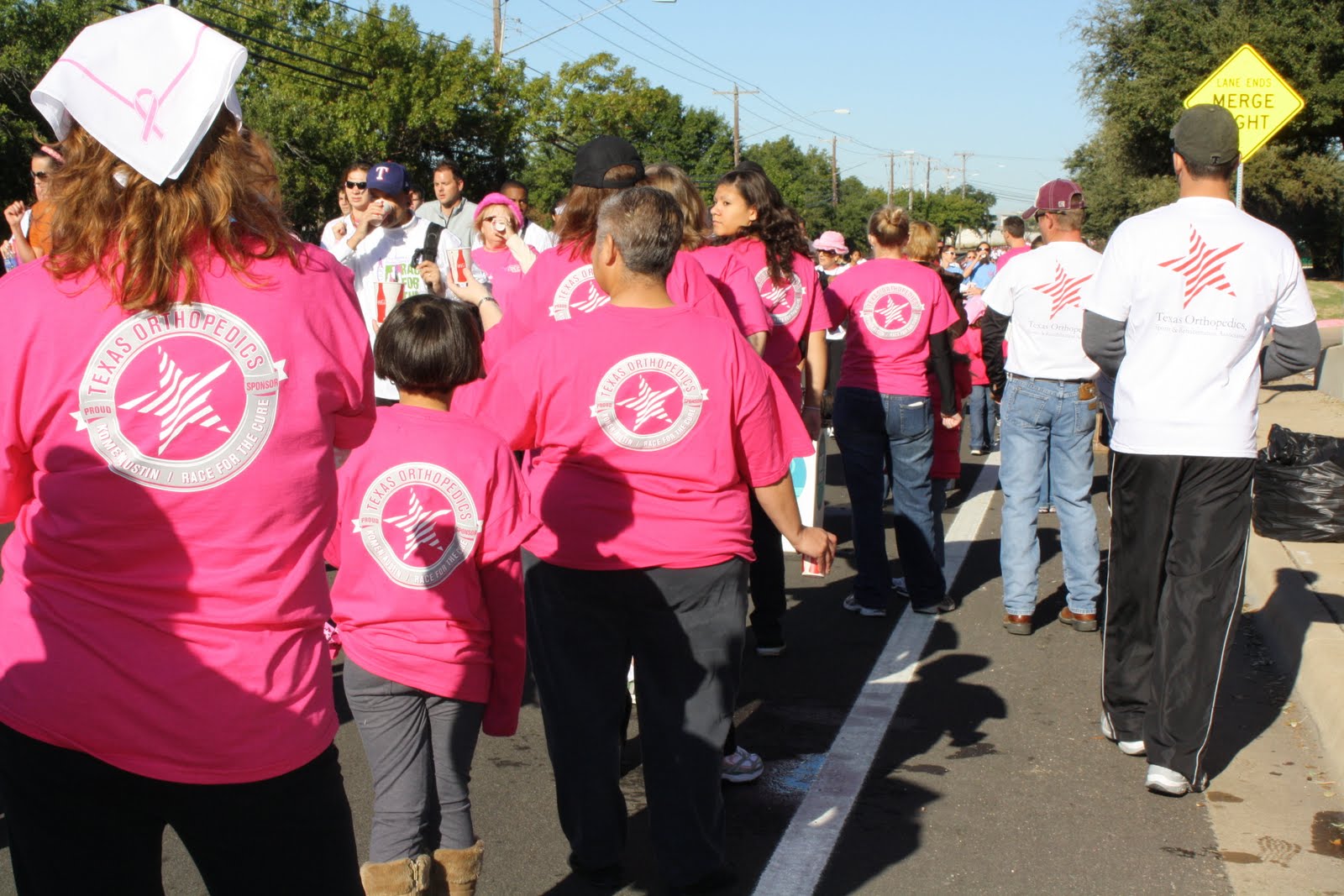
Texas Orthopedics volunteers at Race for the Cure

Texas Orthopedics employees, friends and family passed out water to the Komen Austin Race for the Cure participants Sunday, November 7th!


Monday, November 8, 2010

Pain Pills- part 3


Post provided by Barbara Bergin, MD


So I talked about tapering off pain pills as you feel your need diminish. But what are some other things you can do to decrease your need to take pain pills?
Don’t forget R.I.C.E.: rest, ice, compression and elevation. You’ve used that to help with pain after an injury. Well it works for post-operative pain as well.

Rest: We live in a busy world. We’re always wanting to get somewhere. We’ve got to go, go, go. When I was in college I had a job as a ward clerk in one of the big hospitals in Houston. People stayed in the hospital for weeks after an operation, which nowadays is done as an outpatient case. We don’t have the luxury of trained nurses waiting on us day and night for two weeks after our operation. Most of my patients can’t wait to get back to work, back to play and back to their routines. No one wants to rest. There’s nothing like rest to help us recover from an operation; whether that be resting our whole body or just resting the part on which we had surgery. But you need rest. It’s a crazy concept to take pain pills in order to return to work or to play golf. Stay home a little longer. REST!

Ice: Ice helps slow down the bleeding from the little capillaries in the wound/incision. Bleeding causes swelling and swelling causes pain. Apply ice, lots of ice. You really can’t use too much ice. Just be sure not to let ice bags rest directly on your skin.

Compression: This also helps to control swelling. Applying an ace bandage or thick dressings, when appropriate, helps to control swelling and therefore pain.

Elevation: Elevate the injured extremity as soon and as much as possible. When you allow an injured limb or an extremity which has just had surgery to hang down, it begins to swell. Once that swelling gets out of control, it is really hard to reverse. The more you can elevate the extremity from the get-go, the better.

Many of my patients manage all their pain with R.I.C.E. They might take their pain pills for only a day or two. Think R.I.C.E. instead of pain pill.

Tuesday, November 2, 2010

Pain Pills- part two


Post provided by Barbara Bergin, MD

Last time I mentioned that prescription pain pill abuse was a national health issue. It’s really a difficult problem for doctors and patients. We don’t want any of our patients to get addicted to pain pills, but we also don’t want you to suffer unnecessarily after an injury or surgery. There’s a fine line between relieving the pain and overusing pain pills and it’s different for every patient.

Following a minor operation one patient might not take any pain pills at all, and another patient might take 8 hydrocodones a day for 2 weeks. The second patient might really be suffering from that pain more than the other patient. Their tolerance for pain might be less. But they might also be conditioned to taking lots of pain pills. They might require more because their system is used to taking narcotics. And then, as much as I hate to say it, there is the patient who just wants to get more pain pills. They want to save them for a rainy day. Or they might be sharing them or even selling them to friends and family members. It’s nearly impossible for a physician to know which one they’re prescribing pain pills to. Trust me; we try to figure it out as soon as possible.

But let’s assume you’ve just broken your first bone or you’ve just scheduled your first surgery, and you don’t want to take too many pain pills. But you also don’t want to suffer. How do you know how many pain pills to take, when to take them, and when to stop using them?

The prescription bottle might say to take 1-2 pills every 4-6 hours as needed for pain. At first you will probably take a couple every 4 or 5 hours. Generally speaking, the first couple of days after an injury or surgery are the worst. So after that, start cutting back on the numbers of pills you take. Just take one instead of two. Or start increasing the amount of time you wait before taking your next dose.

You could start taking non-narcotic pain relievers like Tylenol, Aleve or Advil, in between doses, with the plan that eventually you’ll completely switch to the non-narcotic stuff and toss the rest of the pain pills.

I’ve got some other ideas you can read about in a couple of days. I also want to talk about pain pill use in children.

Monday, October 25, 2010

Pain Pills - part 1


Post provided by Barbara Bergin, M.D.

In my line of work, I get a lot of requests for pain pills. The majority of patients who need them have either just had surgery or an injury, like a fracture. And most people stop taking the pain pills as soon as they feel they don’t need them. Sometimes they wean themselves off of them by lowering the numbers of pills they take, or gradually increasing the interval of time in between the narcotics. Sometimes they supplement the pain medications with non-narcotic pain relievers.

But sometimes patients continue to take pain pills. Weeks and even months go by, and they continue to request large doses of pain pills. It’s really hard for some of our patients to gauge how many pain pills they should be taking or how to wean themselves off of them. They start getting into a habit of taking the pills. Maybe they think that if they are experiencing any pain at all, they should go ahead and take the pain pill. Sometimes they use the pain pills to help them sleep at night. And sometimes they use them in order to be able to function without pain during the day. These are all problematic ways in which to use pain pills.

In my opinion it is best to stop taking pain pills as soon as possible. Pain doesn’t actually “hurt” you. It’s a sensation; like hunger or itching. Just because you are hungry, it doesn’t mean you absolutely have to eat. And you don’t have to scratch when you have an itch. You don’t have to relieve pain every time you feel it.

Addiction to prescription narcotic medications is a serious national health problem. In my next blog I’ll talk about some things patients can do to minimize their use of pain pills.

Wednesday, October 6, 2010

Return of Football Season Brings Attention to High Injury Rates and Need for Prevention

Post provided by The American Academy of Orthopaedic Surgeons (AAOS)

According to U.S. Consumer Product Safety Commission:

- The 2009 football season saw over 1.2 million football-related injuries
- Such injuries resulted in more than $2.8 billion total medical costs from treatments in hospitals, doctor's offices, and emergency rooms

"Traumatic injuries to the knee and shoulder as well as concussions are the most common types of injuries we see on both the professional and youth levels," said orthopaedic surgeon Matthew Matava, MD, team physician for the St. Louis Rams and spokesperson for the STOP Sports Injuries campaign and the American Academy of Orthopaedic Surgeons. "Overuse injuries, especially in the beginning of the season, are another big issue with kids pushing themselves too far and too fast without proper conditioning."

The STOP Sports Injuries Campaign was launched in the spring of 2010 by a coalition of leading healthcare organizations to expose the growing epidemic of youth sports injuries related to overuse and trauma.

Because most football injuries can be prevented, the American Orthopaedic Society for Sports Medicine and American Academy of Orthopaedic Surgeons encourage the following easy strategies for parents, coaches, and athletes:

- Have a pre-season health and wellness evaluation to determine ability to participate

- Warm-up properly with low-impact exercises like jogging that gradually increase the heart rate

- Consistently incorporate strength training and stretching. A good stretch involves not going beyond the point of resistance and should be held for 10-12 seconds

- Hydrate adequately to maintain health and minimize cramps

- Play multiple positions and/or sports during the off-season to minimize overuse injuries

- Wear properly fitted protective equipment and do not modify equipment

- Cool-down properly to gradually lower heart rate with exercises like light jogging or stretching

- Don't play through the pain. Speak with an orthopedic surgeon who specializes in sports medicine or athletic trainer if you have any concerns about injuries or tips on injury prevention

Monday, September 13, 2010

You Kick Like A Girl

Post provided by the American Academy of Orthopaedic Surgeons.

Significant differences in knee alignment and muscle activation exist between men and women while kicking a soccer ball, according to a study published in the Journal of Bone and Joint Surgery. Data reveals that males activate certain hip and leg muscles more than females during the motion of the instep and side-foot kicks - the most common soccer kicks - which may help explain why female players are more than twice as likely as males to sustain an anterior cruciate ligament (ACL) injury.

Prior research shows that females are more prone to non-contact ACL injuries than males and though many theories exist, a direct cause for the disparity is unknown. "By analyzing the detailed motion of a soccer kick in progress, our goal was to home in on some of the differences between in the sexes and how they may relate to injury risk, " said orthopedic surgeon Robert H. Brophy, MD, study author and assistant professor of orthopedics, Washington University School of Medicine in St. Louis. "This study offers more information to help us better understand the differences between male and female athletes, particularly soccer players."

The study found that male players activate the hip flexors (inside of the hip) in their kicking leg and the hip abductors (outside of the hip) in their supporting leg more than females. "Since females have less activation of the hip abductors, their hips tend to collapse into adduction during the kick, which can increase the load on the knee joint in the supporting leg, and potentially put it at greater risk for injury, " Dr. Brophy said.

In 2008, the Centers for Disease Control and Prevention published a study that found a new training program called the Prevent Injury and Enhance Performance (PEP) program, was effective in reducing ACL injuries in female soccer players. Developed by the Santa Monica Orthopedic and Sports Medicine Research Foundation and supported by the American Academy of Orthopaedic Surgeons among other medical and athletic associations, PEP is an alternative warm up regimen that focuses on stretching, strengthening and improving balance and movements and can be conducted during regular practice time and without special equipment. "Programs focusing on strengthening and recruiting muscles around the hip may be an important part of programs designed to reduce a female athletes' risk of ACL injury, " said Dr. Brophy.