Call Today: (877) 966-7846 | (512) 439-1000
Texas Orthopedics, Sports & Rehabilitation Associates

Wednesday, September 30, 2015

Strong Hips = Happy Knees


If you are a runner, there's a good chance you've suffered from "runner's knee" at some point. While the pain originates in the knee joint, there's another joint not too far away that can help combat this pain... the hip joint.

New research suggests that rehabilitation exercises incorporating the hip - instead of just the knee - can help alleviate this patellofemoral pain, or runner's knee.

Scientists reviewed 14 separate studies involving runners, and here is what they discovered: 
  • Performing exercises to build strength and endurance in the hip muscles led to decreased knee pain and improved joint function when compared with therapy focused on quadriceps muscles alone. 
  • Using heavy weights to strengthen hip and glute muscles proved beneficial over the long-term.
  • Alternating movements/reps between the knee and hip while performing rehab exercises was associated with reduced pain and improved function. 
Because runner's knee can flare up frequently, it is ideal to keep hip conditioning as part of your regular running routine. Using a resistance band is helpful, as well as the following exercises for strengthening hips: 
If your knee pain is constant or severe, contact us

(Adapted from Runner's World

Keep up with Texas Orthopedics news by following us on Facebook and Twitter (@TexasOrthopedic).

Monday, September 28, 2015

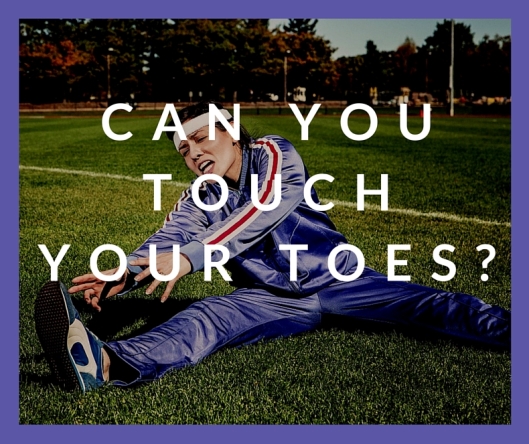
Can You Touch Your Toes?


Can you touch your toes? Really touch them? Proper form dictates that you bend all the way at the waist/hips and fold over similar to closing an old-fashioned flip phone.

So why is this such a challenging, physical task for so many? For one thing, our flexibility wants as we age. Another factor is likely the amount of time we spent sitting at a desk or in a car these days.

Sitting for long periods of time causes your hip flexors to actually shorten. The hip flexors attach to the mid and lower back and are instrumental in bending, along with your abdominals and glutes.

If the hip flexors are shortened or tightened, flexibility can decrease in your core, and ultimately throughout your entire body.

To keep hip flexors surrounding tissues limber, here are just a few exercises to try a couple of times a week, and you will be touching your toes in no time!

Hip Flexor Release
  • Use two balls together (lacrosse balls work well), and lay your stomach with balls placed just below hip bone. 
  • Bend the knee on the side of the release back to a 90-degree angle.
  • Swing leg side to side for several reps repeat.
SI Mobilization (for the Sacroilic joint in the pelvis)
  • Lay on one end of a foam roller so that the tip of foam roller is flush against center of pelvis. 
  • Raise both legs up with knees straight and repeat.
Inner Thigh Squats
  • Place feet shoulder width apart with toes out at a 45-degree angle.
  • Squat as you bring hips back like you are sitting in a chair that is too far behind you.
  • Extend knees outward, and lower yourself as much as possible while keeping balance, then repeat.
If you experience severe pain with these, or any new exercise or workout, you may want to give us a call.

(Courtesy of Men's Journal).

Keep up with Texas Orthopedics news by following us on Facebook and Twitter (@TexasOrthopedic).

Wednesday, September 23, 2015

Men's Bones vs. Women's Bones


Men are from Mars, and women are from Venus so the saying goes. And now research suggests that how a man's and woman's body reacts to injury or illness may be quite different, particularly for orthopedic injuries.

A recent report in the June issue of Journal of the American Academy of Orthopaedic Surgeons analyzed several studies on the difference between male and female orthopedic issues. Here are a few highlights:

Bones:
  • Men are more vulnerable to fractures in fingers and hands.
  • Women suffer more fractures or sprains to ankles and feet, likely due to high-heeled shoes.
Muscles/tendons: 
  • These soft-tissue injuries are more common in men, such as tears to the Achilles tendon, distal biceps, quadriceps and pectoral tendons. 
  • Men suffer Achilles tendon tears about three times as often as women. 
Osteoporosis:
  • Women are more susceptible to hip fractures from osteoporosis, but men with osteoporosis who have hip fractures are more apt to suffer serious complications. 
  • Although osteoporosis strikes men and women, it is generally perceived to be a women's disease and often goes overlooked in men.
 Knees:
  • Women are at higher risk for Anterior Cruciate Ligament (ACL) tears than men, especially when playing certain sports. This may be due to reproductive hormones affecting joint looseness as well as anatomical differences in pelvis width, leg alignment, and knee articulation. 
  • Following an ACL tear, women are less likely than men to return to a sport and are at greater risk of injuring the opposite knee/ACL in the future. 
The results are interesting. We're already seeing gender-specific guidance on ACL injuries and other injuries and expect to see more with additional comprehensive studies.  

(Courtesy of U.S. News & World Report - Health).

Keep up with Texas Orthopedics news by following us on Facebook and Twitter (@TexasOrthopedic).
Monday, September 21, 2015

Texas Orthopedics Honors National Rehabilitation Awareness Week

Rehabilitation is the final, and arguably most important, step in the recovery process following a serious injury or surgery. It is also a routine ritual for those with lifelong or newly diagnosed disabilities.

In honor of our patients who are currently undergoing rehabilitation, and the dedicated physical therapists working alongside them, Texas Orthopedics celebrates National Rehabilitation Awareness Week, September 20-26. 


This week is organized each year by the National Rehabilitation Awareness Foundation (NRAF) in order to educate people about the benefits and impact of rehabilitation and physical therapy. Additionally, the foundation aims to increase opportunities for the nearly 50 million Americans with disabilities while helping them live up to their fullest potential.

At Texas Orthopedics, formal rehabilitation, or physical therapy, is often prescribed to treat pain or restore mobility and function after surgery or an injury. Our highly trained therapist work closely with our doctors to develop personalized treatment plans and help patients return to their favorite activities as safely and efficiently as possible. Therapeutic exercises, modalities, special equipment, and manual techniques are all used to aid the rehabilitation process.

Thank you, PTs, for keeping our patients whole.

Keep up with Texas Orthopedics news by following us on Facebook and Twitter (@TexasOrthopedic).

Wednesday, September 16, 2015

New Study Says It's True, Apple (Peels) Keep Doctor Away for Elderly

New medical research suggests that a chemical found in apple peels and green tomatoes could help reduce muscle wasting in the elderly.

The University of Iowa scientists discovered two natural compounds that cause muscle weakness and loss during ageing - Ursolic acid, which is found in apple peel, and Tomatidine, found in green tomatoes.

According to Nature World Report, the scientists tested ursolic acid and tomatidine on mice to see if they reduced age-related muscle weakness and atrophy. The study found that the two compounds increased muscle mass by 10% and muscle quality, or strength, by 30%.

The researchers believe that the two compounds could be used for dealing with muscle weakness and atrophy during aging. We look forward to hearing more about this latest discovery.

Read the full study in the Journal of Biological Chemistry.

Monday, September 14, 2015

Says Dr. Bergin: Respect Your Pinky Toe


Dr. Barbara Bergin, orthopedic surgeon and one of the founders of Texas Orthopedics, regularly keeps up a blog offering health tips based on patient issues and injuries she treats. The most recent one is from her "respect" series of blogs... Respect Your Pinky Toe.

Last week I saw two pinky toe fractures (attached to patients of course). I estimate that I see at least one broken or dislocated pinky toe a month, sometimes more. If I multiply that by 12, and then again by the 34 years I've been practicing, that's over 400 pinky toe injuries. Then keep doing more math to see how many pinky toe injuries we might see in my group, or in the city of Austin... THE WORLD. It's a lot!

I'm pretty sure 99% of these injuries are 100% preventable. Because most of the time my patients stub those helpless little appendages on a bed or a door frame which has been in the exact same place for many years...

If I ever break my own pinky toe, I will be very embarrassed to face my patients with broken pinky toes, because I occasionally tease them about how they sustained these very painful injuries. But on a serious note, I then tell them they must turn on lights at night. They must reach out to feel the end of their bed. They must be aware of the location of their bed and their door frames! Because there's no special brace or shoe. There's no vitamin. There's no exercise!

Just remember where your toe and your bed are! And if you can't do that in the dark, then turn on a light! It's that easy to prevent an injury which hurts like hell, keeps you from wearing a regular shoe for a month, eliminates all forms of exercise for six weeks and is frankly just embarrassing to tell people about.

- Dr. Barbara Bergin

Read more of Dr. Bergin's insights on her personal blog: http://drbarbarabergin.com


Wednesday, September 9, 2015

Congrats to Our Austin Monthly Top Docs


Every year, local magazine Austin Monthly publishes a list of best doctors within various medical specialties. While we believe all of our doctors are top notch, we are especially proud to have two of our orthopedic surgeons, Dr. Peter Garcia and Dr. James Smith, make the magazine's 2015 list.

The Austin Monthly list is compiled by Castle Connolly Medical, a health care research and information company.